

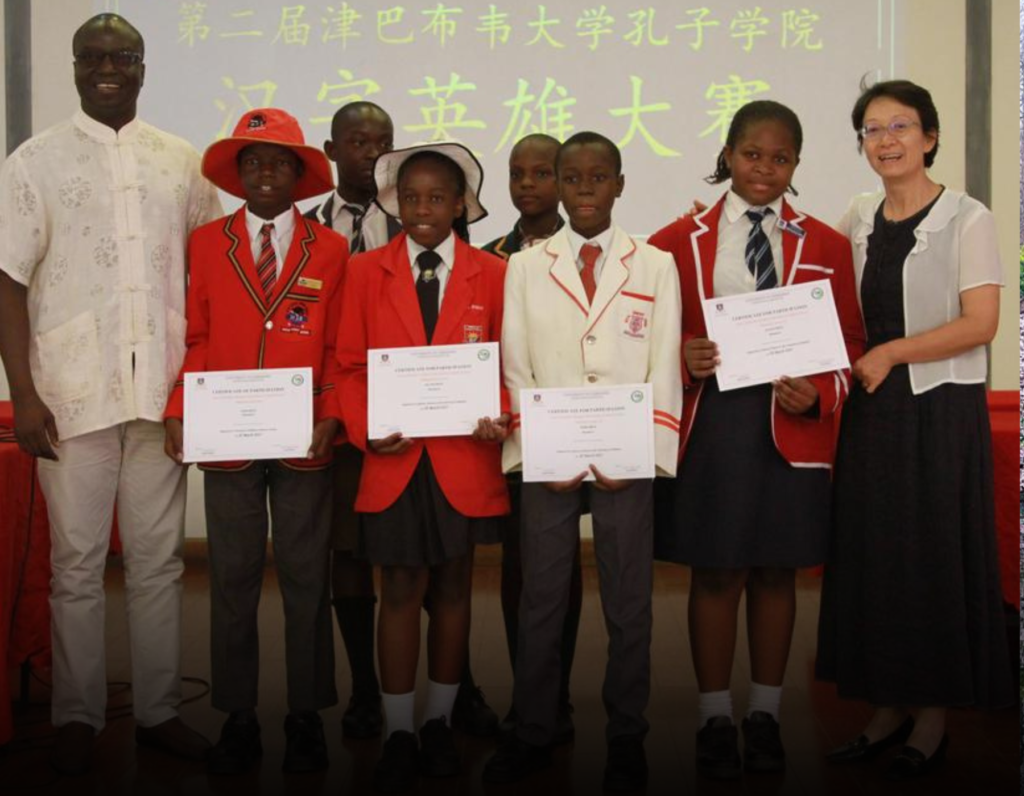
In Harare, the strokes of Chinese characters are becoming symbols of something deeper – connection, opportunity, and a growing partnership between nations.
The Confucius Institute at the University of Zimbabwe recently hosted the third edition of the Chinese Character Hero Competition, bringing together students and educators in a celebration of language and cultural exchange. The event, designed to sharpen Mandarin proficiency, tested participants on reading, writing, and sentence construction under time constraints – challenging both skill and confidence.
At the heart of the competition was a simple but powerful idea: language builds bridges. As Fainos Mangena, Dean of the Faculty of Arts and Humanities, noted, the event was “more than a contest,” describing it as a platform that “fosters mutual understanding and strengthens the bond of friendship between Zimbabwe and China.”
The competition reflects a wider trend. Across Zimbabwe, interest in learning Chinese has been steadily rising, driven by expanding economic ties and cultural exchange programs.
Participants from primary schools to tertiary institutions, demonstrated not only technical ability but also enthusiasm for engaging with a language often seen as complex yet rewarding. Cathrine Nkala, who emerged as the top performer in the tertiary category, captured this sentiment, encouraging others by saying learning Chinese is “very possible” and “interesting.”
This enthusiasm is not new. Previous competitions, including the widely recognised “Chinese Bridge” contest, have shown that Zimbabwean students increasingly view Mandarin as a gateway to scholarships, careers, and global engagement. One participant in earlier events described the language as “a bridge between the two countries,” highlighting its practical and symbolic value.
Institutions like the Confucius Institute have played a central role in this transformation. Established globally to promote Chinese language and culture, these institutes operate through partnerships with local universities, providing teaching resources, training, and cultural programming.
In Zimbabwe, the Confucius Institute at the University of Zimbabwe has been instrumental in expanding Mandarin education since its establishment, supporting both formal curricula and extracurricular initiatives like competitions, cultural festivals, and exchange programs.
Chinese Ambassador to Zimbabwe, Zhou Ding, emphasised that young learners are becoming “an integral part” of people-to-people exchanges, noting that every effort in mastering the language contributes to strengthening bilateral ties.
The rise of Mandarin education in Zimbabwe is closely tied to a broader and deepening China-Zimbabwe relationship.
China is one of Zimbabwe’s key economic partners, with cooperation spanning infrastructure, mining, agriculture, and energy. Chinese-backed projects – including airport expansions, power generation initiatives, and agricultural technology programs – have played a visible role in Zimbabwe’s development trajectory.
At the same time, educational and cultural exchanges continue to grow. Zimbabwean students are increasingly accessing scholarships to study in China, while Chinese institutions support local capacity-building efforts across sectors.
Language, in this context, becomes more than communication – it becomes strategy.
What unfolded in Harare is part of a larger narrative. A generation of young Zimbabweans is positioning itself at the intersection of culture and commerce, equipped with skills that transcend borders.
As Mangena observed, embracing languages like Chinese prepares students to “thrive in trade, diplomacy, and cultural exchange.”
And in a world where global connections define opportunity, the ability to speak across cultures is no longer optional – it is essential.
From chalkboards to global platforms, Zimbabwe’s investment in language is quietly shaping its future – one character at a time.