

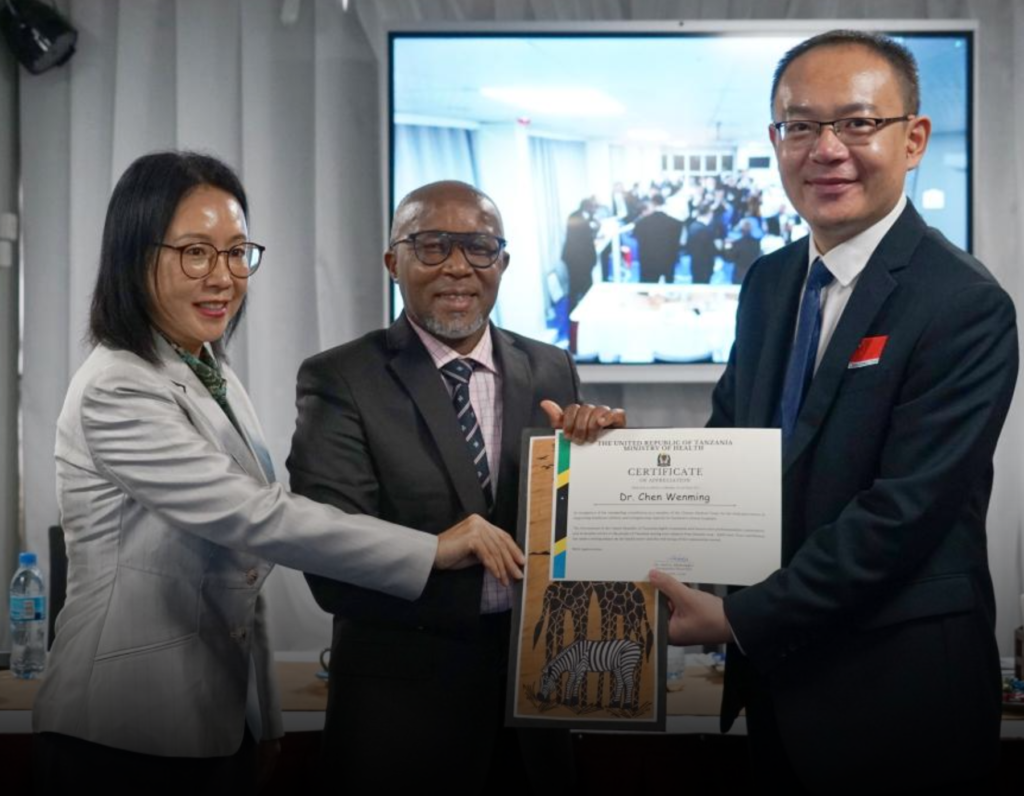
In Dar es Salaam, a quiet but powerful transition unfolded – one that speaks not only to continuity, but to commitment.
China has officially handed over duties between its 27th and 28th medical teams in Tanzania, marking another chapter in one of the longest-running health cooperation programs between China and Africa. The ceremony brought together senior Tanzanian health officials and Chinese representatives, reinforcing a partnership that has spanned more than half a century.
Speaking at the event, Seif Shekalaghe, Permanent Secretary in Tanzania’s Ministry of Health, praised the Chinese medical teams for their “vital role” in delivering healthcare services, technical support, and training. He noted that their contributions have significantly improved both service delivery and the overall well-being of Tanzanians.
Chinese Ambassador Chen Mingjian reflected on the depth of the relationship, highlighting that China first dispatched medical teams to Zanzibar in 1964 and later to mainland Tanzania in 1968. Since then, 35 teams have served in Zanzibar and 28 on the mainland, collectively treating around 20 million patients.
This continuity tells a larger story – one of sustained engagement, not short-term intervention.
The incoming 28th Chinese medical team comprises 15 specialists across key disciplines, including anesthesiology, neurosurgery, and cardiovascular medicine.
Team leader Liu Jia emphasised that the group will focus on Tanzania’s evolving healthcare needs, working closely with local professionals to strengthen medical capacity and improve patient outcomes.
Their mission goes beyond treatment – it is about knowledge transfer, system strengthening, and long-term impact.
The ceremony also paid tribute to Zhang Junqiao, the late head of the 27th medical team, who lost his life in 2025 while rescuing a local resident from drowning. His sacrifice, honored by both Chinese and Tanzanian representatives, underscored the human dimension of this partnership – one built not just on policy, but on shared humanity.
The work of Chinese medical teams in Tanzania continues to deliver tangible results. In recent months, teams have conducted free clinics serving hundreds of patients in underserved regions, offering services ranging from diagnostics to chronic disease management.
In Dar es Salaam alone, outreach programs and medical camps have brought specialized care closer to communities, with patients praising the professionalism and accessibility of Chinese doctors.
Over the past two years, the 27th team treated more than 10,000 patients, highlighting the scale and consistency of their contribution.
Healthcare cooperation is just one pillar of a much broader bilateral relationship.
China and Tanzania share deep historical ties, dating back to landmark projects such as the TAZARA Railway, a symbol of early China–Africa cooperation. Today, the partnership spans infrastructure, trade, energy, and technology.
Recent projects, including stadium construction, transport infrastructure, and industrial investments highlight how the relationship continues to evolve, combining development with people-centered initiatives.
The handover ceremony is more than a procedural transition, it is a signal of continuity in a rapidly changing world.
At a time when global health systems face increasing pressure, partnerships like this demonstrate the value of long-term cooperation rooted in trust, consistency, and shared goals.
For Tanzania, it means improved access to care and strengthened local capacity.
For China, it reflects a sustained commitment to global health engagement.
And for both, it represents a model of cooperation where impact is measured not just in agreements – but in lives improved, skills transferred, and systems strengthened.