

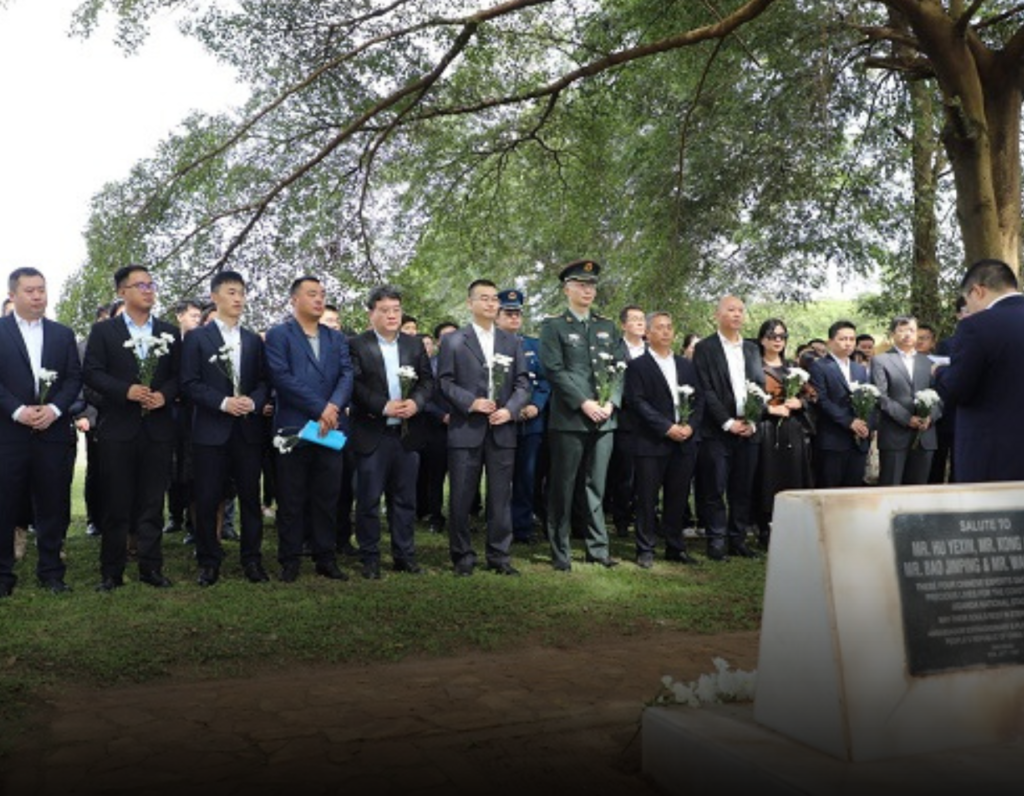
In Kampala, remembrance met reflection as the Chinese community in Uganda gathered to honor four engineers whose legacy is etched not only in stone, but in the foundations of a nation’s sporting identity.
At a memorial ceremony held at the Mandela National Stadium, diplomats, business leaders, and representatives of Chinese institutions paid tribute to four Chinese experts who lost their lives in 1996 while working on the construction of the China-aided national stadium.
Dressed in solemn attire, attendees laid flowers at a memorial stone bearing the names of Hu Yexing, Kong Huiping, Bao Jinping, and Wang Guorui – engineers whose work helped bring one of Uganda’s most iconic infrastructure projects to life.
The Mandela National Stadium, often referred to locally as Namboole, stands as a symbol of Uganda’s sporting pride and international cooperation. Built between 1993 and 1997 with Chinese assistance, the facility has since hosted major national and international events, becoming a central hub for football and athletics in the country.
Speaking at the ceremony, Chinese Embassy representative Fan Xuecheng described the fallen experts as embodiments of “internationalism,” noting that their contributions continue to inspire future generations. He added that the stadium itself is a “testament to shared destiny and joint efforts” between China and Uganda.
Their sacrifice, he emphasised, is “embedded in every inch of this soil,” reinforcing the enduring bond between the two nations.
The commemoration was held ahead of the Qingming Festival – a traditional Chinese occasion dedicated to honoring ancestors and remembering the deceased. This cultural context added deeper meaning to the ceremony, blending remembrance with reflection on shared history.
Participants also highlighted the importance of preserving the values demonstrated by the fallen experts: dedication, resilience, and a commitment to international cooperation.
The stadium project is just one chapter in a long-standing relationship between China and Uganda.
Uganda was among the earliest African countries to establish diplomatic ties with China in the 1960s. Since then, cooperation has expanded across infrastructure, healthcare, education, and trade. Chinese companies have played key roles in building roads, energy facilities, and public institutions, contributing to Uganda’s development trajectory.
Medical teams from China have also supported Uganda’s healthcare system for decades, while scholarships and training programs continue to strengthen human capital development.
Infrastructure projects like the Mandela National Stadium carry meaning beyond their physical structure. They represent collaboration, shared ambition, and long-term commitment.
As Li Jincheng, president of the China Chamber of Commerce in Uganda, noted in related remarks, such projects stand as enduring symbols of friendship – reminders of what can be achieved through cooperation and mutual respect.
The ceremony in Kampala was not just about looking back – it was about carrying forward a legacy.
It served as a reminder that behind every major project are individuals whose efforts and sometimes sacrifices make progress possible.
In honoring these four experts, China and Uganda reaffirmed a partnership built not only on infrastructure and investment, but on shared history and human connection.