

On the shores of Tanzania’s Zanzibar archipelago, traditional Chinese medicine is quietly transforming lives.
For a local fisherman struggling with persistent physical pain that threatened both his livelihood and daily routine, relief came not through surgery or expensive medication, but through acupuncture treatment provided by Chinese medical professionals working in Tanzania.
The story reflects the growing impact of Chinese medical cooperation in Tanzania, where traditional Chinese medicine (TCM), particularly acupuncture, is gaining recognition among local communities for its affordability, effectiveness, and human-centered approach to care.
According to reports from Zanzibar, the fisherman had experienced prolonged physical discomfort linked to the demanding nature of his work at sea. After conventional treatment options provided limited relief, he turned to acupuncture services offered by Chinese doctors at Mnazi Mmoja Hospital, Zanzibar’s main public healthcare facility.
The treatment reportedly helped ease his pain significantly, allowing him to regain mobility and return to fishing activities that support his family’s income.
Chinese medical teams working in Tanzania say such stories have become increasingly common as more Tanzanians explore alternative treatment methods rooted in traditional Chinese medicine.
Over the years, acupuncture clinics established by Chinese medical teams have treated thousands of patients suffering from chronic pain, migraines, muscle strain, arthritis, and stress-related conditions.
Traditional Chinese medicine has steadily gained popularity in Zanzibar and mainland Tanzania due to growing public awareness and long-standing China-Tanzania medical cooperation.
Chinese medical teams have been operating in Tanzania since the 1960s, making the partnership one of Africa’s oldest and most sustained international health cooperation programs. China first dispatched medical teams to Zanzibar in 1964 and later expanded services to mainland Tanzania in 1968.
To date, Chinese medical teams have reportedly treated around 20 million Tanzanian patients while contributing to local healthcare delivery, specialist training, and technical support.
Acupuncture has emerged as one of the most visible aspects of that cooperation.
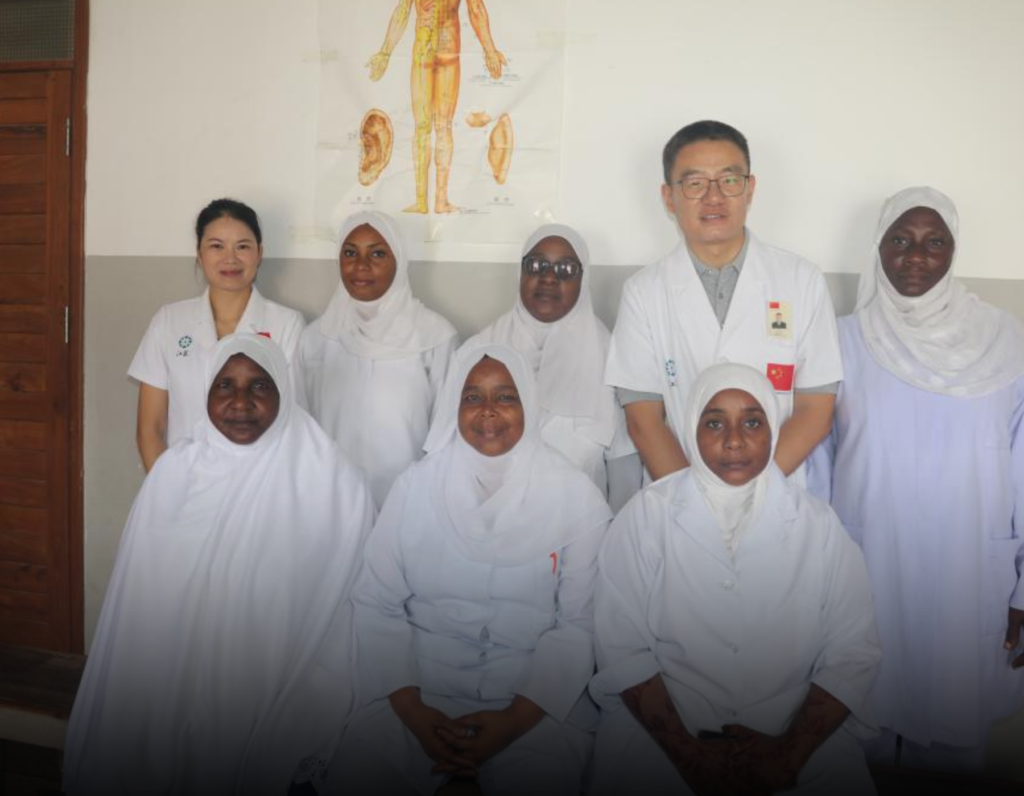
At Mnazi Mmoja Hospital, Chinese doctors regularly provide acupuncture, cupping therapy, tuina massage, and herbal treatment while also training Tanzanian healthcare workers in TCM techniques. A key feature of the cooperation is skills transfer.
Chinese doctors in Zanzibar have increasingly focused on training local nurses and medical staff to independently perform basic acupuncture and other TCM procedures.
Some Tanzanian healthcare workers now actively assist in acupuncture clinics after receiving years of practical instruction from Chinese specialists.
Healthcare officials say the approach is helping expand treatment access while building local medical capacity in alternative healthcare methods.
China-Tanzania relations extend far beyond medicine. The two countries maintain one of Africa’s strongest bilateral partnerships, built historically on projects such as the Tanzania-Zambia Railway Authority (TAZARA), a landmark symbol of China-Africa solidarity completed in the 1970s.
Today, cooperation spans infrastructure, trade, agriculture, education, tourism, technology, and healthcare.
In recent years, China has supported Tanzania through hospital partnerships, anti-malaria programs, schistosomiasis prevention campaigns in Zanzibar, medical training initiatives, and rural healthcare outreach projects.
Chinese medical teams have also organized free community clinics, emergency response training, and public health education campaigns across Tanzania.
While China-Africa relations are often discussed in terms of trade figures and infrastructure investment, stories like that of the Tanzanian fisherman reveal a more personal dimension of international cooperation.
For many patients, the impact of medical assistance is immediate and deeply human – relief from pain, restored mobility, and renewed ability to work and support their families.
Medical experts say acupuncture’s growing acceptance in Tanzania also reflects broader global interest in complementary and alternative medicine, particularly treatments that are minimally invasive and cost-effective.
Observers note that health cooperation has become one of the strongest pillars of China’s engagement with Africa because of its direct impact on communities.
In Tanzania, Chinese doctors are not only providing treatment but also building relationships through compassion, cultural exchange, and practical healthcare support.
For the fisherman whose recovery allowed him to return to the sea, the experience represented more than medical treatment – it became a reminder that international partnerships can sometimes be felt most clearly at the individual level.