

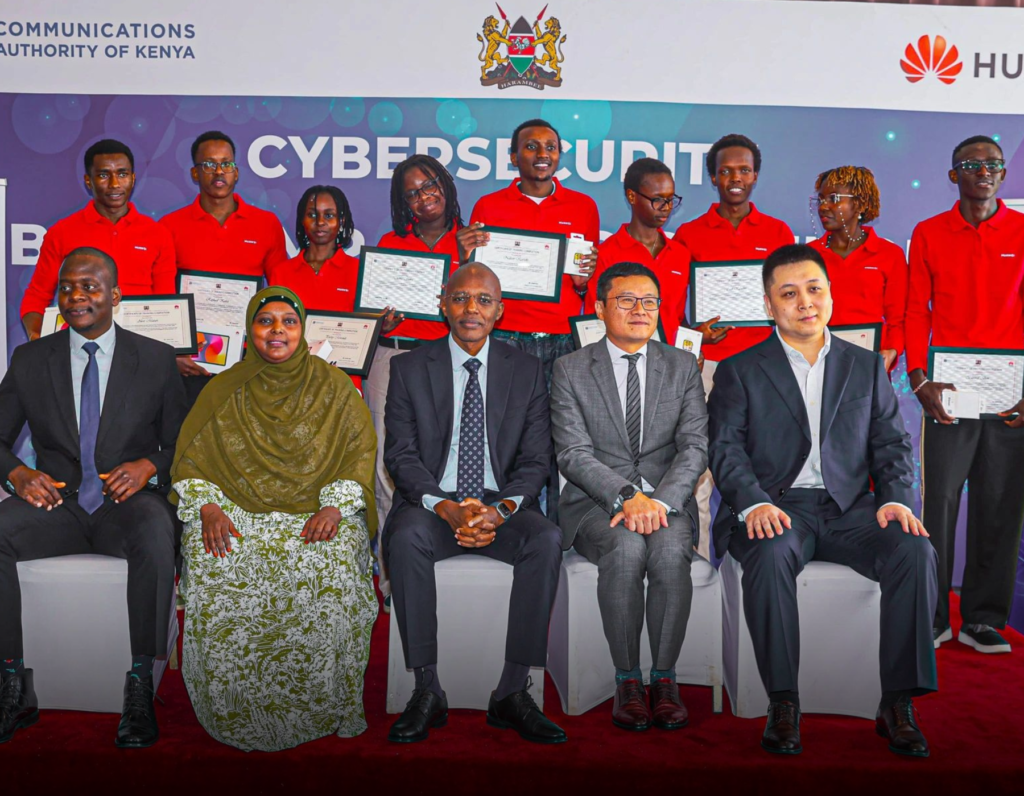
Kenya has recognized top finalists of a Huawei-sponsored cybersecurity bootcamp, highlighting the country’s growing focus on digital security, youth innovation, and advanced ICT skills development as cyber threats continue to rise across Africa.
The award ceremony, held in Nairobi on Wednesday, celebrated university students and young tech professionals who participated in the national cybersecurity training program organized through a partnership between Huawei, the Kenya National Innovation Agency, and other local technology stakeholders.
The bootcamp focused on strengthening practical cybersecurity skills among Kenyan youth through hands-on training in network security, ethical hacking, cyber defense systems, cloud technologies, and digital risk management.
Speaking during the event, Kenyan officials emphasized that cybersecurity is becoming increasingly critical as the country accelerates digital transformation across government services, financial systems, education, and business operations.
John Tanui, principal secretary in Kenya’s Ministry of ICT and the Digital Economy, reportedly said the bootcamp aligns with Kenya’s broader strategy to develop a highly skilled digital workforce capable of supporting the country’s expanding technology ecosystem. He noted that investments in digital talent are essential for strengthening innovation and securing Kenya’s digital future.
Participants underwent intensive mentorship and technical assessments designed to simulate real-world cybersecurity challenges. Organizers said the program aimed not only to identify talent, but also to help bridge Africa’s widening cybersecurity skills gap.
Huawei Kenya officials described the initiative as part of the company’s broader commitment to digital inclusion and ICT talent development across Africa. According to the company, empowering young people with cybersecurity expertise is increasingly important as African economies become more digitally interconnected.
The competition also reflects Kenya’s emergence as a leading technology hub in Africa, supported by a thriving startup ecosystem, rapid mobile innovation, and increasing investment in digital infrastructure.
Over the past decade, Kenya has become internationally recognized for advancements in fintech, mobile money systems, e-government services, and digital entrepreneurship. However, experts warn that growing digitization also exposes institutions and businesses to rising cyber risks, including data breaches, fraud, ransomware attacks, and financial cybercrime.
According to the African Union and cybersecurity industry estimates, cybercrime costs African economies billions of dollars annually, underscoring the urgent need for stronger digital security capacity and workforce training.
Huawei has significantly expanded its digital skills programs in Kenya and across Africa through initiatives such as ICT Academies, Seeds for the Future, cloud computing certification programs, and smart campus partnerships with universities and government institutions.
The latest cybersecurity initiative also ties into broader China-Kenya cooperation in the digital economy. Chinese companies have played a visible role in Kenya’s telecommunications infrastructure, fiber-optic expansion, smart city projects, cloud services, and digital public service systems.
Earlier this week, Huawei signed another cooperation agreement with the Kenya School of Government to support digital transformation and ICT capacity building within Kenya’s public sector. The partnership focuses on training government officials in artificial intelligence, cloud computing, cybersecurity, and digital governance systems.
Beyond technology, China and Kenya maintain strong bilateral relations in infrastructure, trade, education, transport, healthcare, and industrial development. Beijing has financed several major projects in Kenya, including the Standard Gauge Railway, highways, energy facilities, and connectivity infrastructure.
Analysts say digital cooperation is rapidly becoming one of the most strategic pillars of China-Africa relations as African governments seek to modernize economies and prepare young populations for technology-driven industries.
For many of the students recognized at the bootcamp, the competition represented more than an academic exercise. It offered a glimpse into the future of Africa’s digital workforce – one increasingly shaped by cybersecurity expertise, innovation, and cross-border technology partnerships.
As Kenya continues positioning itself as East Africa’s leading digital economy, initiatives like the Huawei-sponsored bootcamp are expected to play a growing role in nurturing the next generation of African cyber professionals.