

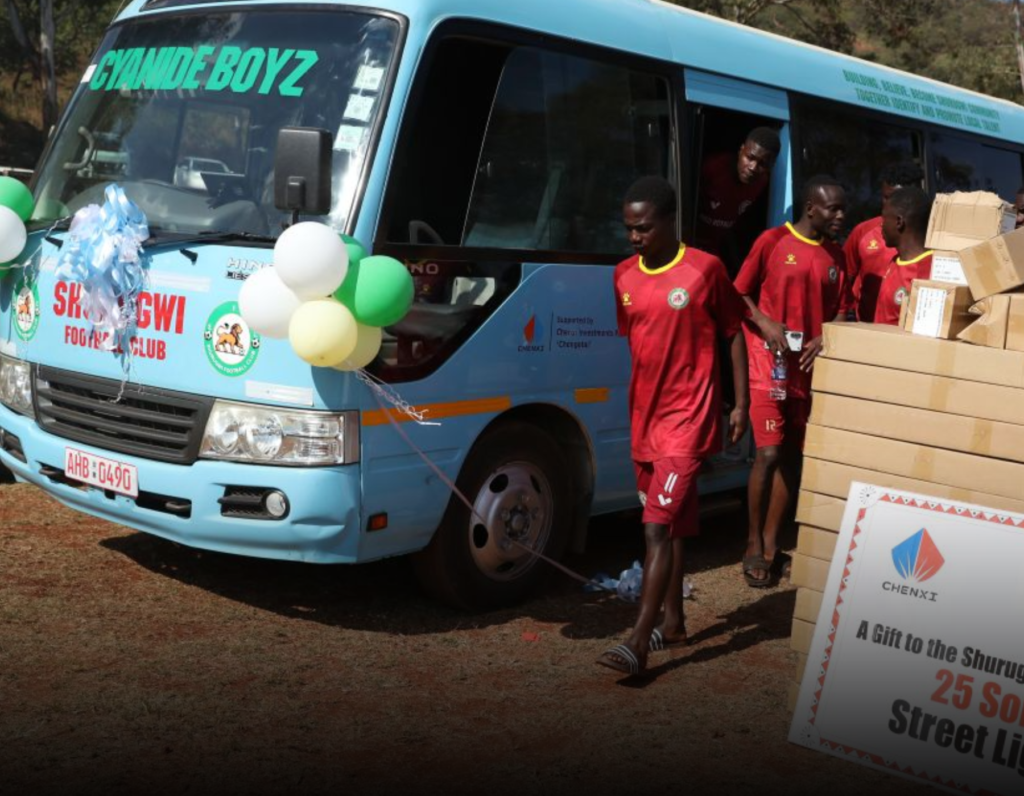
In the gold-mining town of Shurugwi, a ceremony this week turned a spotlight on a different side of Chinese investment in Zimbabwe, not tonnes of ore extracted, but streetlights installed, a football club’s new mini-bus and a broader push to fold community development into the mining business itself.
Owen Ncube, Zimbabwe’s minister of state for provincial affairs and devolution for Midlands Province, used Monday’s event in Shurugwi to commend Chinese gold mining firm Chenxi Investments for its contributions to both the local economy and community life, framing the company’s corporate social responsibility work as aligned with Zimbabwe’s national goal of reaching upper-middle-income status by 2030. During the ceremony, 25 solar streetlights were handed over to the Shurugwi Town Council and a mini-bus to the Shurugwi Football Club, both donated by the mining firm.
The donations are the latest installment of a $2 million comprehensive CSR program Chenxi has budgeted for 2026, which also sets aside funding for a community dam, a market center, village business units and an expansion of Shurugwi District Hospital that includes new staff accommodation. “Today’s event demonstrates Chenxi’s robust, people-centric empowerment initiatives in Shurugwi and the broader Midlands Province, spanning health, education, agriculture, SMEs and mining,” Ncube said.
Beyond the visible infrastructure, the company says it has backed local economic empowerment more directly by providing mining claims and equipment to artisanal miners in the area and setting up a community milling plant. Chenxi Investments director Simon Karimanzira said the company fully supports the Zimbabwean government’s mineral value-addition strategy, aimed at maximizing revenue from processed rather than raw mineral exports and credited the country’s favorable investment climate with drawing a growing wave of Chinese investors into the sector.
Karimanzira also outlined the company’s expansion plans. Chenxi, which began open-cast gold mining operations in 2022, intends to build what would become Midlands Province’s largest carbon-in-pulp processing plant, with a daily capacity of 3,000 to 4,000 tonnes of ore. A facility expected to substantially boost both processing capacity and gold recovery rates. The company has also developed an 11-megawatt solar energy facility, due for commissioning soon, aimed at insulating its operations from the power shortages that have increasingly plagued the region amid climate-related disruptions to hydropower generation.
Chenxi’s recognition comes at a moment when Chinese mining investment in Zimbabwe as a whole is facing considerably more mixed reviews. Chinese-owned firms account for an estimated 90 percent of Zimbabwe’s mining sector, according to the Harare-based Centre for Natural Resource Governance and that scale of presence has drawn sustained scrutiny from environmental and labor advocates. Separate operations elsewhere in the country, including a gold mine in Manicaland’s Mutasa District and a lithium operation at Bikita, have faced government-ordered shutdowns and community complaints over blasting damage, water contamination and inadequate environmental impact consultation in recent years. Labor unions have also raised concerns in some cases about wages and working conditions at Chinese-run mine sites. Zimbabwean officials overseeing those disputes have generally said affected companies remain obligated to compensate residents and meet local regulatory requirements and some firms have responded with their own local CSR spending, though community advocates in a few instances have questioned whether donations substitute for accountability rather than complement it.
None of those specific complaints have been raised in connection with Chenxi’s Shurugwi operations and Monday’s ceremony instead reflected the more cooperative model Zimbabwean officials say they want to see replicated: government and mining companies, treating community infrastructure and mineral value-addition as complementary goals rather than competing ones.
The Shurugwi ceremony fits into a China-Zimbabwe economic relationship built substantially around mining and resource investment. Chinese Ambassador to Zimbabwe Zhou Ding has said Chinese investment currently supports roughly a million jobs across the Zimbabwean economy, with China standing as the country’s largest single source of foreign direct investment. Flagship projects include Dinson Iron and Steel’s operations and a wave of Chinese-backed lithium processing investment, alongside cement, power generation and broader industrial manufacturing, much of it concentrated in the same Midlands region where Chenxi operates.
That investment has taken on new urgency following the completion, announced just this week, of Zimbabwe’s zero-tariff export certification process under China’s duty-free trade policy for African goods. An arrangement expected to boost demand for Zimbabwean minerals, tobacco and horticultural exports alike. Zimbabwean economist Dereck Goto has described the current phase of China-Zimbabwe engagement as the latest layer of a roughly two-decade shift from straightforward trade toward deeper industrialization support, with mining investment and community-facing CSR programs like Chenxi’s increasingly presented by officials on both sides as evidence that the relationship’s benefits are meant to reach local communities directly, not just company balance sheets.
Whether that promise is being delivered consistently across Zimbabwe’s mining sector remains a live and contested question. But in Shurugwi this week, at least, the message from local officials was straightforwardly positive: streetlights installed, a football team on the move, and a mining company positioning itself as a partner in the town’s development rather than simply an extractor of its resources.