

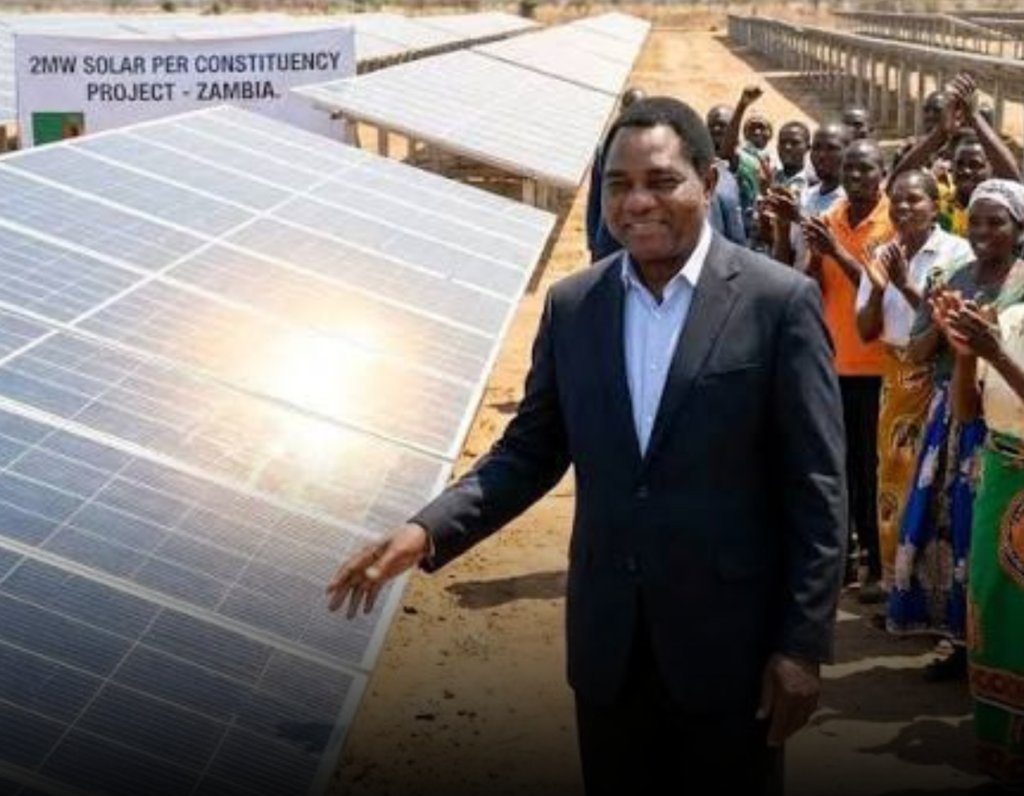
Zambia is betting on the sun to fix a power problem that has plagued the country for years. On Tuesday, the government signed contracts with a consortium of five Chinese firms to design, supply and install 2-megawatt solar photovoltaic plants in every one of Zambia’s 156 constituencies, a rollout intended to bring localized power generation to every corner of the country at once.
The agreement falls under the Presidential Constituency Energy Initiative, a flagship government program cabinet approved in November 2025 as part of a broader push to lift Zambia’s electricity generation capacity from its current 3,500 megawatts to 10,000 megawatts by 2030. Nicholas Phiri, permanent secretary for technical services in the Ministry of Local Government and Rural Development, said the initiative is meant to spearhead a nationwide renewable energy rollout aimed at eliminating structural power deficits while building local wealth in communities that host the plants.
“The program is directly aligned with Zambia’s broader macro-economic and developmental goals,” Phiri said, noting that folding these solar assets into the national grid supports the country’s long-term capacity-expansion target. Beyond the electricity itself, he said the initiative is expected to stimulate local economic growth, create jobs and strengthen service delivery at the constituency level, with 70 newly created constituencies added this year also set to receive their own plants under the program.
The nationwide rollout builds directly on Zambia’s recent solar momentum. Just a year earlier, in June 2025, President Hakainde Hichilema commissioned the 100-megawatt Chisamba Solar Plant, the country’s largest grid-connected solar project at the time, built by PowerChina International Group as engineering, procurement and construction contractor, with Stanbic Bank and state utility Zesco providing financing. At that commissioning, Hichilema praised the Chinese contractor for a partnership he said reflected a broader shift in bilateral cooperation, from state-to-state arrangements toward more direct business-to-business and people-to-people ties, adding that Zambia’s goal was to secure enough electricity for both domestic consumption and export. Chinese embassy counselor Wang Li said at the time that the project reflected the strength of a bilateral relationship elevated to a comprehensive strategic and cooperative partnership in 2023, and confirmed Beijing’s continued commitment to helping Zambia hit its 1,000-megawatt solar target.
That 1,000-megawatt solar ambition has been advancing on multiple fronts. In January 2026, Zambia signed a memorandum of understanding with Chinese firms LONGi Solar Technology and Sino Green Technology to develop up to 1 gigawatt of solar capacity nationwide, with a 100-megawatt pilot plant in Itezhi-Tezhi District serving as the first project under that framework. The Ministry of Energy noted the agreement followed Hichilema’s 2025 state visit to China, and pointed out that Zambia had already imported 500 megawatts of Chinese solar panels in 2025 alone, 300 megawatts of them manufactured by LONGi. Separately, China Datang Corporation signed a framework agreement with Zesco during the most recent Forum on China-Africa Cooperation to deliver 220 megawatts of new solar capacity by 2026.
The urgency behind Zambia’s solar push traces back to a punishing drought that began devastating the country’s hydropower-dependent grid in 2024. With roughly 83 percent of Zambia’s electricity historically generated by hydropower, falling water levels at Kariba Dam and other reservoirs triggered blackouts stretching up to 21 hours a day in some areas, costing the economy an estimated $1.3 billion, ie, about 5 percent of GDP, according to one economist’s estimate. Energy Forum Zambia chairperson Johnstone Chikwanda has said the crisis forced a fundamental rethink of the country’s energy mix, framing solar as the nation’s genuine “safe zone” going forward. Not every past Chinese-backed energy project in Zambia has run smoothly. However, a 2016 solar-powered milling plant initiative financed by a $170 million China Development Bank loan fell short of its full rollout targets, with government audits later finding hundreds of the plants non-functional, a reminder that execution and maintenance remain real challenges even when financing and technology are in place.
Zambia’s solar push sits within one of China’s oldest and most consistent African partnerships. Diplomatic ties between the two countries date to 1964, the year of Zambian independence, and the relationship carries deep historical weight through the TAZARA Railway the China-built line linking landlocked Zambia’s Copperbelt to the Tanzanian coast, completed in the 1970s and now marking its 50th year of operation alongside a newly agreed revitalization project.
The 2023 elevation of ties to a comprehensive strategic and cooperative partnership has coincided with a broader diversification of that cooperation beyond traditional mining and infrastructure lending, into the kind of direct business and technology partnerships now driving the solar buildout. For a country whose energy security has been shaken by climate-driven drought, the constituency-by-constituency rollout represents an attempt to convert a crisis into a more resilient, more distributed power system; with Chinese engineering, financing and manufacturing now embedded in nearly every stage of that effort.