

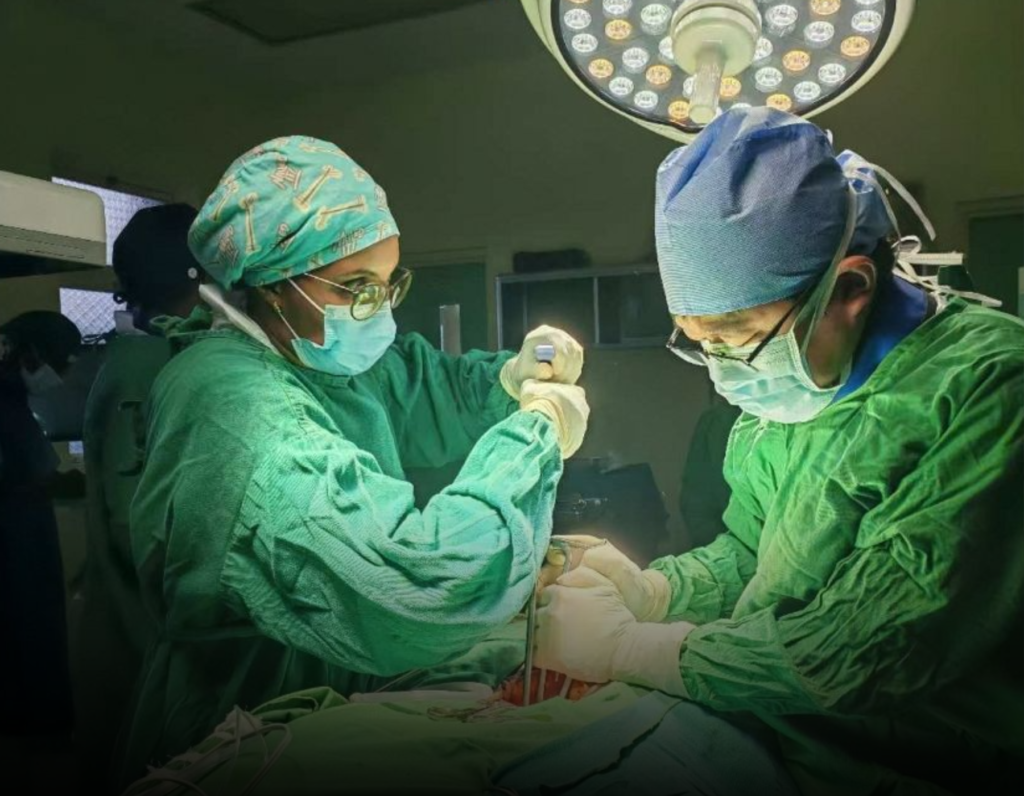
Matilda Chisuguru had already been through one spine operation and expected it to be the end of her ordeal. Instead, it became the beginning of a much harder chapter, one that only ended more than a year later, on an operating table in southwestern Tanzania under the hands of a visiting Chinese surgeon.
The 46-year-old entrepreneur and mother of two from Mbeya first underwent lumbar decompression and internal fixation surgery in Dar es Salaam roughly a year ago, hoping it would resolve chronic back pain. For a few months it seemed to work. Then, six months on, her condition collapsed. Severe lower back pain returned alongside numbness in both legs and near-constant radiating discomfort. “I could not walk on my own,” she recalled. “The pain in my back and legs was constant.”
Her path back began at Mbeya Zonal Referral Hospital, where Zhou Chao, a spine surgeon with the 28th Chinese medical team serving in Tanzania, took on her case. What he found during his initial examination made clear this would be no routine follow-up procedure. The earlier surgery had left scar tissue and severe adhesions wrapped around critical nerves, while signs of vertebral damage raised the possibility of chronic infection. Weakened bone structure and loosened screw tracks from the original hardware meant any new fixation would carry real technical risk. Revision spine surgery ranks among the most demanding procedures in orthopedics under ideal conditions; Chisuguru’s case offered anything but ideal conditions.
The hospital’s equipment compounded the difficulty. The available C-arm X-ray imaging system, essential for guiding precise screw placement, produced low-quality images, while surgical instruments including; electrosurgical units worn down by years of repeated use, performed inconsistently. Working within those constraints, Zhou designed a surgical plan built around safety and practicality rather than reliance on equipment the hospital simply didn’t have.
On June 15, Zhou and his colleagues carried out the procedure: carefully removing the unstable original screws, performing bone grafting to reinforce the damaged vertebrae and preparing new pathways for fixation. The most delicate stage involved separating scar tissue from surrounding nerve structures without causing further damage, painstaking. Deliberate work that, given the imaging limitations, leaned heavily on the surgical team’s experience and anatomical knowledge rather than real-time visual guidance. Step by step, they achieved neural decompression, restored spinal stability and secured new pedicle screws. The operation succeeded and it marked the first lumbar revision surgery of its kind ever performed at Mbeya Zonal Referral Hospital.
Recovery came quickly in the days that followed. Under medical supervision, Chisuguru began light physical exercises, a critical first step toward regaining mobility. “I can feel that my body is improving,” she said. “What they have done is not just treatment; it is something that gives hope.” Her determination has only grown since. “I believe I will walk again,” she said.
For Zhou, the case was one entry in a longer mission. “We are here to serve, to share and to learn,” he said. “Every patient teaches us something and every success encourages us to do more.”
Chisuguru’s surgery is the latest chapter in a Chinese medical presence in Tanzania that has rotated through 28 successive teams, part of a program that traces back six decades to China’s first medical mission to the country. That same broader mission has been active elsewhere in Tanzania in recent months. In Zanzibar, a separate Chinese medical team recently performed the region’s first laparoscopic hiatal hernia repair for a 76-year-old patient, while other teams have run free community health outreach clinics under China’s “100 Medical Teams in 1,000 Villages” program and donated imaging equipment to hospitals across the islands.
Mbeya itself, a city in Tanzania’s southern highlands roughly 850 kilometers from Dar es Salaam, has drawn international medical partnerships before including; past collaborations between Mbeya Zonal Referral Hospital and American academic medical teams on training and quality-improvement initiatives. What distinguishes the Chinese mission is its scale and continuity: successive rotating teams providing not just occasional specialist visits but sustained, embedded clinical service and skills transfer over the better part of six decades.
The Mbeya surgery adds to a China-Tanzania relationship that has been expanding across multiple fronts this year. Ties were elevated to a Comprehensive Strategic Cooperative Partnership following talks between President Xi Jinping and President Samia Suluhu Hassan in 2024 and bilateral trade surpassed $10 billion for the first time in 2025, with a zero-tariff policy for Tanzanian exports to China taking effect on May 1, 2026. The two countries also marked the 50th anniversary of the Tanzania-Zambia Railway’s operation earlier this month alongside a newly launched $1.4 billion project to revitalize the line, while a separate UN-backed, China-supported vocational training program has been equipping young Tanzanians with job skills in the country’s Mtwara region.
Healthcare remains one of the steadiest threads running through that broader relationship. A form of cooperation less tied to trade cycles or infrastructure financing than to the accumulated trust of decades spent training local doctors, treating patients. In Chisuguru’s case, filling capability gaps that would otherwise send patients home without options. For a woman who spent more than a year believing her mobility was permanently gone, that trust translated into something far more immediate than diplomacy: a second chance to walk.