
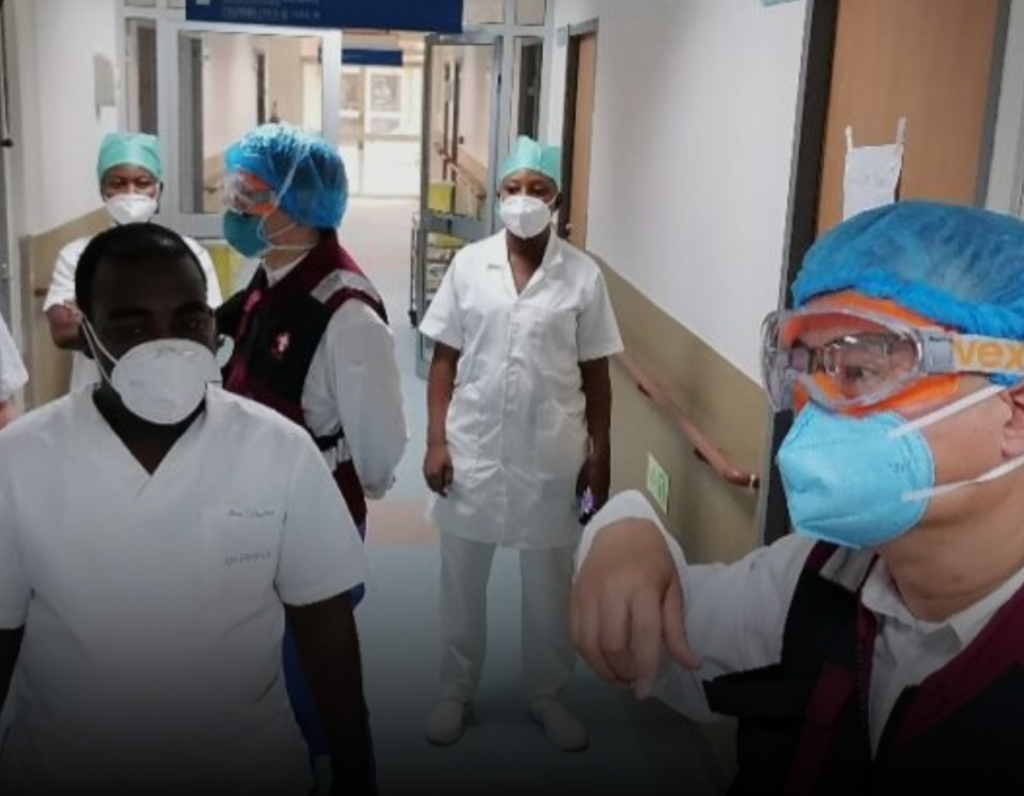
Doctors from China’s 17th medical mission to Burkina Faso handed over a fresh consignment of medical equipment to Ouagadougou’s Tengandogo University Hospital Center on Friday, the latest installment in a health partnership between the two countries that stretches back five decades, despite a decades-long diplomatic interruption in between.
The donation, worth 32 million CFA francs (roughly $56,000), included equipment for diagnosing and treating cardiovascular disease alongside general patient-care devices. Chinese Ambassador to Burkina Faso Zhao Deyong and Burkina Faso’s Minister of Health and Public Hygiene, Robert Lucien Jean-Claude Kargougou, both attended the handover ceremony in the capital.
Zhao framed the gesture within a much longer arc of cooperation, noting that China has continuously dispatched medical teams to Burkina Faso and donated supplies over the years, calling the practice a vivid embodiment of the friendship between the Chinese and Burkinabe peoples. He tied the donation to 2026’s designation as the China-Africa Year of People-to-People Exchanges, saying China remains ready to deepen practical health cooperation with Burkina Faso and help build what he described as a China-Africa community of health for all.
Kargougou, for his part, praised the record of bilateral health cooperation and thanked China specifically for its support across hospital infrastructure, academic exchange, personnel training, the steady supply of medicines and medical equipment, adding that he looks forward to further cooperation in the sector.
The health partnership behind Friday’s ceremony has a more layered history than the warm diplomatic language suggests. China’s first medical mission arrived in Burkina Faso in 1976, three years after the two countries established diplomatic relations in 1973 under the country’s former name, Upper Volta. Between that first mission and 1994, China sent a total of nine medical teams comprising 163 personnel to the country, while also hosting Burkinabe students in China.
That cooperation came to an abrupt halt in February 1994, when Burkina Faso switched diplomatic recognition to Taiwan, prompting Beijing to suspend relations entirely. The two countries went 24 years without formal diplomatic ties, during which Taiwan maintained an embassy in Ouagadougou and supported projects including Burkina Faso’s National Blaise Compaoré Hospital, at the time West Africa’s first fully computerized general hospital.
That chapter closed in May 2018, when Burkina Faso announced it was severing relations with Taiwan and, two days later, formally restored diplomatic ties with Beijing in a ceremony where Chinese Foreign Minister Wang Yi and his Burkinabe counterpart, Alpha Barry, signed a joint communique in Beijing. China’s medical missions resumed shortly after, and the country has now received six additional teams since 2018. This brings the cumulative total to 17 and counting, the batch marking Friday’s donation. Chinese Premier Li Keqiang, meeting Burkinabe President Roch Marc Christian Kaboré ahead of the 2018 FOCAC summit, pledged to prioritize cooperation in agriculture, healthcare, human resources and energy sectors he said touched directly on ordinary people’s livelihoods.
The relationship has continued evolving since Burkina Faso’s political landscape shifted dramatically in 2022, when Captain Ibrahim Traoré seized power in a coup and began steering the country toward economic nationalism, expanded state control over its gold sector and a broader realignment away from former security partners including France. China and Burkina Faso elevated their relationship to a formal strategic partnership in 2024 and Chinese arms sales to the Burkinabe government have reportedly increased since, including the delivery of more than 100 armored vehicles, according to U.S. congressional research. Bilateral trade reached $741 million in 2024, up nearly 25 percent from the previous year, according to Chinese Foreign Ministry figures, though the balance remains heavily tilted toward Chinese exports, which accounted for the large majority of that total.
China’s overall economic footprint in Burkina Faso remains comparatively modest next to its presence in some other African economies, but analysts note the relationship carries strategic weight for a government that has deliberately sought out non-Western partners while battling a long-running jihadist insurgency. Unlike Russia, which has supplied mercenary forces and security assistance directly tied to counterinsurgency operations, China’s engagement with the Traoré government has stayed concentrated in more traditional areas; trade, infrastructure, arms sales and, as this week’s ceremony illustrated, sustained healthcare cooperation that predates the current government by decades and has continued largely uninterrupted by Burkina Faso’s recent political turbulence.
For Tengandogo Hospital, the immediate outcome of that history is more concrete than geopolitical: new cardiovascular diagnostic equipment and patient-care devices now in service at one of Ouagadougou’s teaching hospitals, courtesy of a medical relationship that has survived a diplomatic rupture, a return and, this year, a formal upgrade to strategic-partner status.