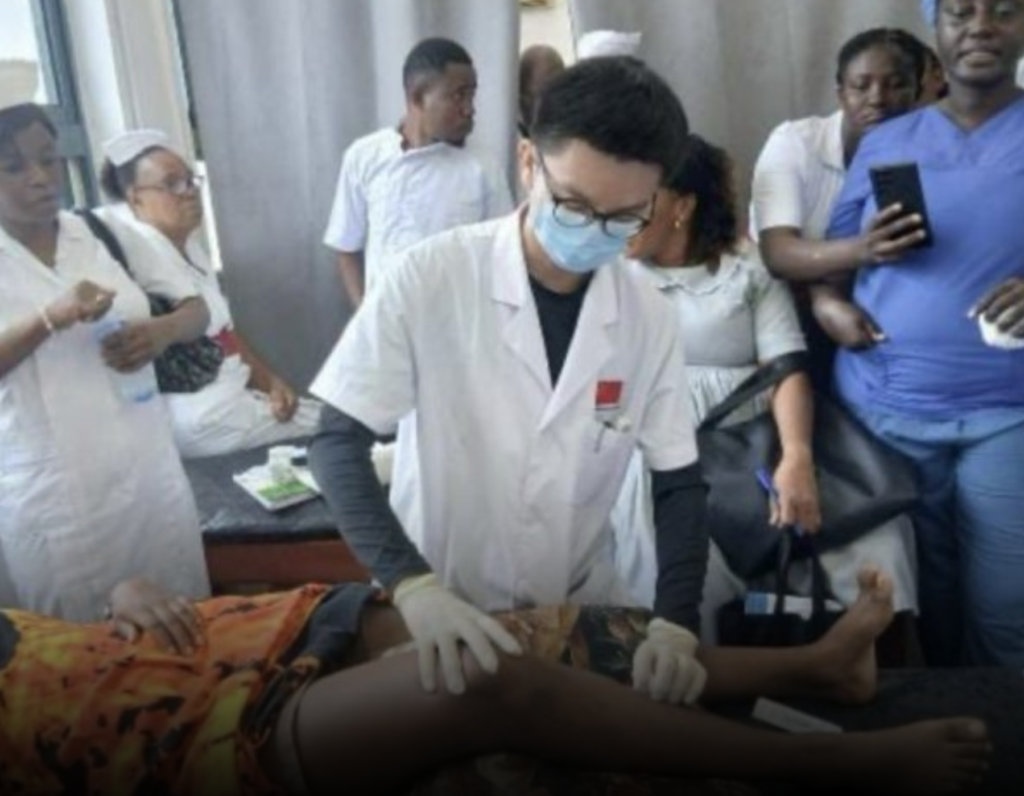
More than 40 Sierra Leonean nurses spent Saturday learning acupuncture techniques with names most had never encountered before, Fu’s Subcutaneous Needling, Gua Sha, moving cupping, as China’s medical mission to Sierra Leone opened a new training program built to blend a Hunan classroom with a Freetown clinic in real time.
The inaugural session took place at the Telemedicine Center of the Sierra Leone-China Friendship Hospital, run under the newly established China-Sierra Leone Nursing Training Center. The program, delivered by the 27th batch of the Chinese Medical Team, pairs remote lectures from medical experts based in China’s Hunan Province with hands-on demonstrations led by Chinese specialists physically present in Freetown. A hybrid format designed to extend Hunan’s specialist expertise into a Sierra Leonean hospital without requiring every instructor to make the trip.
The curriculum follows what organizers describe as a four-dimensional teaching model: theoretical instruction, practical simulation, live question-and-answer exchange and direct participation in clinical rounds. Saturday’s session focused squarely on a problem Sierra Leonean nurses see constantly, chronic neck, shoulder and joint pain, with a Chinese medical expert demonstrating Fu’s Subcutaneous Needling, a modern refinement of acupuncture, using simplified English to keep the technique accessible to participants working in their second or third language. Other sessions covered Gua Sha scraping therapy, moving cupping, moxibustion and therapeutic massage, with instructors stressing standardized technique and patient safety throughout.
Zainab Bangura, a state registered nurse at the Sierra Leone-China Friendship Hospital, said the training addressed a specific hole in her daily work. “This course provides structured, practical knowledge that aligns with our daily clinical demands, addressing a clear gap in pain management services here,” she said. The Chinese medical team said it intends to keep running bilingual TCM workshops through the Telemedicine Center going forward, with the explicit goal of building sustainable local nursing capacity and expanding standardized pain-management services across the country.
Saturday’s workshop was the second major milestone for the new nursing center in as many weeks. The China-Sierra Leone Nursing Training Center officially opened on July 3, with Li Zheng, captain of the 27th Chinese medical team, describing it at the launch as a permanent hub for regular nursing talent development between the two countries rather than a one-off training exercise. Its first specialized session, focused on emergency care, was led by cardiologist Sheng Jie of Xiangya Hospital at Central South University and senior nursing specialist Tan Yan of Hunan Cancer Hospital, both flown in specifically for the occasion.
The center builds on a pattern of skills transfer the Hunan mission has pursued in Sierra Leone for years. In 2019, a pathology team from Hunan Cancer Hospital traveled to the Sierra Leone-China Friendship Hospital to complete the country’s first case of telepathology consultation, later training two local staff members, Donald Samuel Bangura and Wuyah Novella Sheriff, at Hunan Cancer Hospital itself to help the Freetown hospital establish its own pathology department. More recently, in May, specialists from the 27th medical team performed a complex extrafascial total hysterectomy on a patient whose uterus had grown to the size of a seven-month pregnancy. A case local media described as one of the most technically demanding gynecological surgeries the hospital had handled in months.
The Sierra Leone-China Friendship Hospital, located in Jui just outside Freetown, has a history shaped as much by emergency as by routine care. Jointly managed by Sierra Leone’s Ministry of Health and Shandong’s Qushan Hospital, the 100-bed facility was converted into a dedicated infectious disease unit during the West African Ebola outbreak in 2014, with the Chinese medical team working alongside local health authorities before the hospital returned to general treatment duties once the epidemic ended in November 2015. During the COVID-19 pandemic, the same hospital treated 77 confirmed patients, including a dozen children under 14, all of whom recovered; more recently, Chinese and Sierra Leonean teams worked together to bring a 2025 Mpox outbreak under control, treating more than 300 patients before the country declared the outbreak over in December.
China first sent medical personnel to Sierra Leone in 1973, two years after the two countries established diplomatic relations, and has dispatched more than 500 medical staff to the country. A mission that, unlike the disruption experienced by countries such as Burkina Faso, has continued without a diplomatic interruption across five decades.
The training center’s launch lands within a China-Sierra Leone relationship that has been deepening rapidly. Ties were elevated to a Comprehensive Strategic Cooperative Partnership in 2016, and President Julius Maada Bio’s multiple visits to Beijing including a high-profile trip in early 2024, during which he met separately with President Xi Jinping and Premier Li Qiang, have produced a steady stream of new agreements, including a 2023 Economic and Technical Cooperation Agreement and Chinese backing for an estimated $1.5 billion bridge project linking Freetown to Lungi International Airport.
Trade has surged accordingly. Two-way trade reached $1.82 billion in the ten months following the extension of China’s zero-tariff policy to Sierra Leone and 52 other African countries in mid-2025, according to figures published by the Chinese embassy in Freetown, while cumulative Chinese direct investment in the country has climbed to roughly $3 billion. Both governments have also formally committed to advancing China’s Global Development Initiative, Global Security Initiative and Global Civilization Initiative through the partnership, alongside more conventional cooperation in agriculture, mining, fisheries and vocational education.
For the 40 nurses who spent Saturday learning to needle shoulders and scrape stiff necks. The immediate value was more practical than strategic, one more tool added to a public health system that has, over five decades of Chinese medical missions, learned to lean on that partnership in crisis and in the quieter, more routine work of chronic pain management alike.