
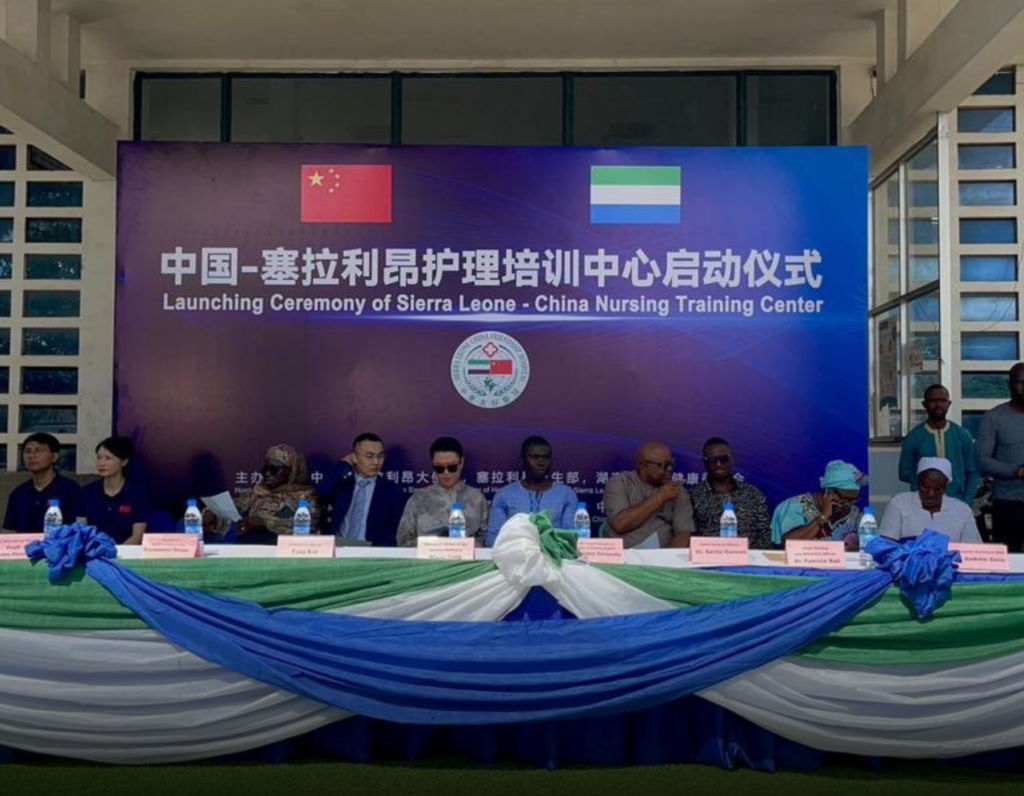
China and Sierra Leone have strengthened their long-standing health partnership with the launch of a new nursing training base at the China-Sierra Leone Friendship Hospital, a move aimed at enhancing clinical skills, improving patient care and supporting the development of the country’s healthcare workforce.
The training base was inaugurated by the 26th Chinese Medical Team in collaboration with Sierra Leone’s Ministry of Health and Sanitation. The initiative is designed to provide structured training for nurses, facilitate knowledge exchange and introduce modern nursing practices that will contribute to higher standards of healthcare delivery across the country.
Speaking at the inauguration ceremony, representatives from both sides described the facility as an important platform for professional development and a new milestone in bilateral medical cooperation.
Members of the Chinese medical team said the training center will focus on strengthening practical nursing skills, infection prevention and control, emergency response, patient safety and specialized clinical care. Through regular workshops, demonstrations and mentoring programmes, Chinese medical experts will work alongside their Sierra Leonean counterparts to build local capacity and promote sustainable improvements in healthcare services.
Officials from Sierra Leone’s Ministry of Health welcomed the initiative, noting that continuous professional training is essential to addressing the country’s growing healthcare needs. They expressed appreciation for China’s continued support in developing medical infrastructure and human resources, emphasizing that better-trained nurses are fundamental to improving patient outcomes and strengthening the national health system.
The China-Sierra Leone Friendship Hospital has become a cornerstone of the two countries’ health cooperation. Since its establishment, successive Chinese medical teams have provided clinical services, performed complex surgeries, introduced new treatment techniques and trained local healthcare professionals, helping expand access to quality medical care.
The latest initiative builds on decades of Chinese medical assistance to Sierra Leone. China first dispatched medical teams to the West African nation in the early 1970s, and over the years hundreds of Chinese doctors, nurses and specialists have served in the country, offering treatment while transferring medical knowledge to local professionals.
Health cooperation between the two countries intensified during the COVID-19 pandemic, when China supplied vaccines, medical equipment, personal protective equipment and technical support to strengthen Sierra Leone’s public health response. Chinese experts have also worked closely with local authorities on infectious disease prevention, maternal and child health, and hospital management.
Beyond healthcare, China and Sierra Leone maintain a broad strategic partnership covering infrastructure, agriculture, education, fisheries, mining and trade. Chinese companies have participated in the construction and rehabilitation of roads, public facilities and energy projects, while educational exchanges and scholarship programmes continue to strengthen people-to-people ties.
The nursing training base also aligns with the commitments made under the Forum on China-Africa Cooperation (FOCAC), where both sides have pledged to expand cooperation in public health, medical education and healthcare capacity building. Increasing emphasis has been placed on developing local expertise to ensure African countries can build resilient and self-sustaining health systems.
Medical experts say investing in nursing education is particularly significant, as nurses form the backbone of healthcare delivery and play a central role in disease prevention, emergency care and community health services.
As the new training base begins operations, both China and Sierra Leone expect it to become a lasting platform for clinical education, professional exchange and innovation, reinforcing a partnership that has evolved from medical assistance into long-term capacity building for a stronger healthcare system.