
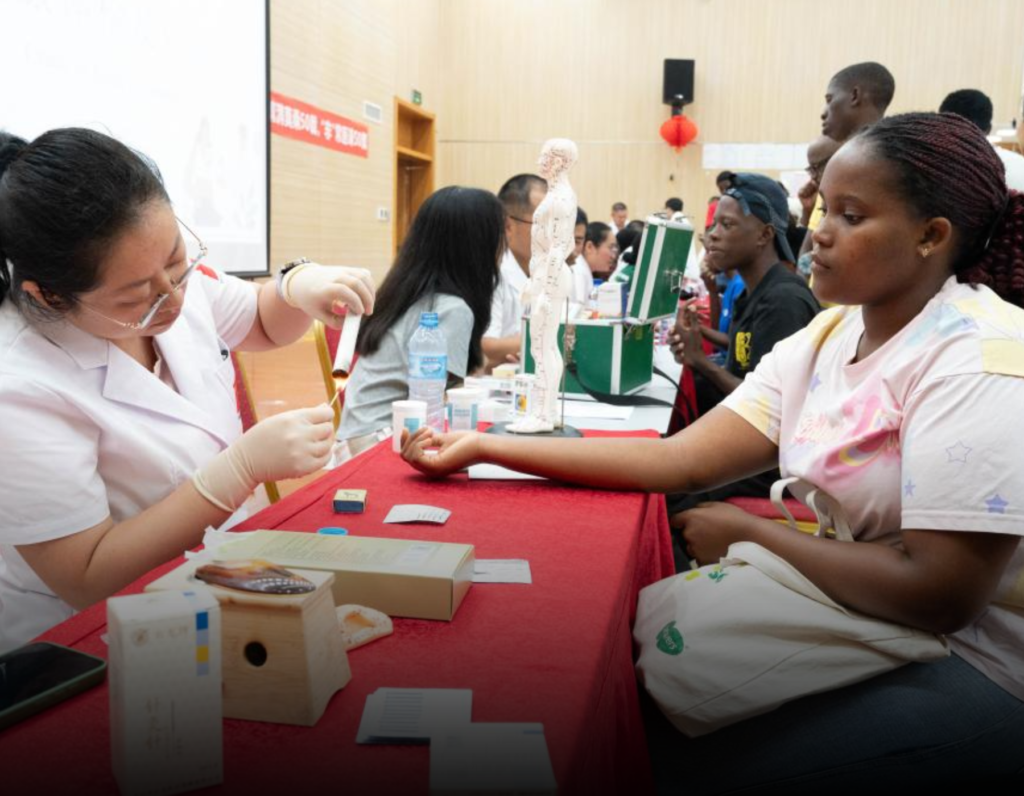
In Maputo, healthcare met outreach, where medicine was not only administered, but shared as knowledge.
The 25th Chinese medical team in Mozambique has conducted a free clinic and health awareness campaign at the Confucius Institute of Eduardo Mondlane University, offering both treatment and education to local residents.
The initiative combined clinical services with public health education, an approach increasingly seen as essential in strengthening healthcare systems.
Doctors provided consultations and basic health examinations across multiple specialties, including orthopedics, plastic surgery, and obstetrics and gynecology.
At the same time, the team introduced traditional Chinese acupuncture therapy, explaining its principles and benefits to participants. According to team member Zhu Hongyu, the goal was not only treatment but also to help people “experience the unique value” of traditional Chinese medicine.
Beyond consultations, the outreach placed strong emphasis on prevention, an area critical to Mozambique’s public health strategy.
To mark Mozambican Women’s Day on April 7, the team organized targeted sessions focusing on the prevention of diseases such as HIV/AIDS, while offering practical health guidance to participants.
Local representatives welcomed the initiative, noting that such programs improve both health awareness and access to basic care, particularly in communities where medical resources can be limited.
China’s medical cooperation with Mozambique dates back to 1976, making it one of the longest-running bilateral health partnerships on the continent.
Over the decades, successive Chinese medical teams have provided clinical services, training, and community outreach – ranging from free clinics to disease prevention campaigns.
Recent initiatives have included free medical services in rural and underserved areas, as well as health education programs addressing malaria, cholera, and chronic diseases.
Mozambique’s healthcare system, while improving, continues to face challenges such as limited access to clinicians and reliance on external support for medicines and infrastructure.
In this context, outreach programs like free clinics play a crucial role – not only in treating patients but also in easing pressure on formal health facilities and improving early diagnosis.
Medical cooperation is just one dimension of a wider bilateral relationship. China and Mozambique have deep ties spanning infrastructure, energy, agriculture, and education. Chinese firms have been involved in major infrastructure projects, while educational and cultural exchanges, such as those hosted at Confucius Institutes, continue to strengthen people-to-people connections.
Notably, 2026 has been designated as the China–Africa Year of People-to-People Exchanges, further emphasising initiatives that connect communities beyond government-level engagement.
What unfolded in Maputo was more than a medical outreach, it was a model of integrated cooperation.
In a healthcare landscape where prevention is as critical as cure, such initiatives highlight a simple truth: sustainable impact comes from combining both.