

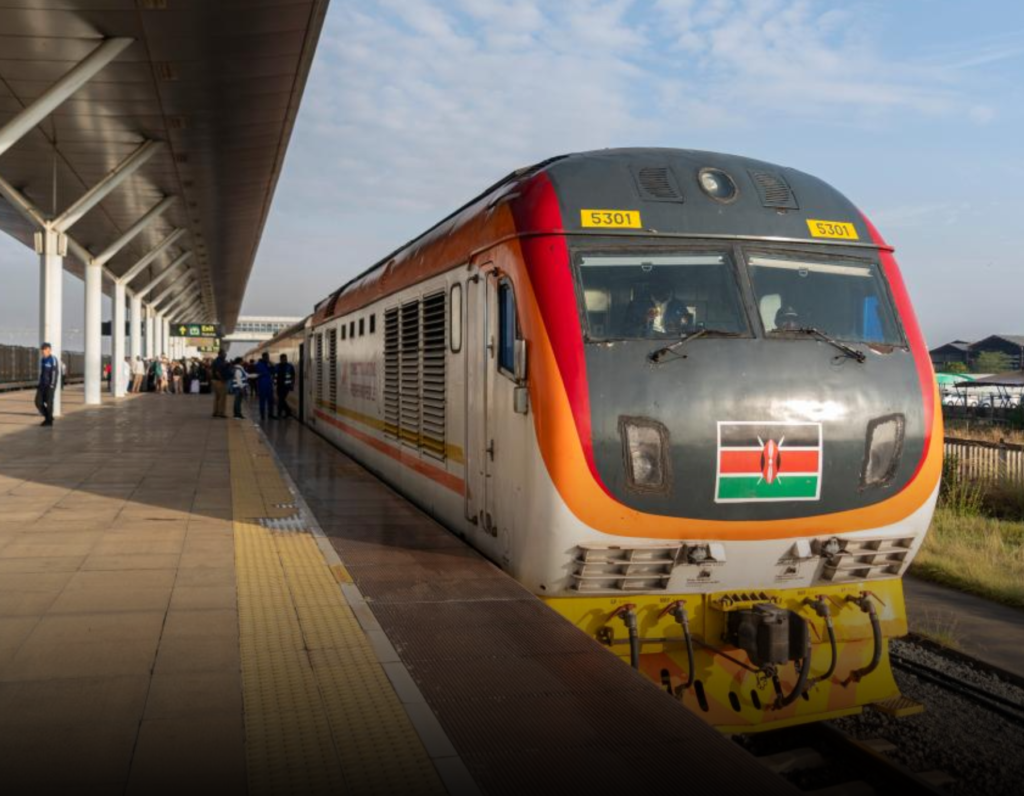
Kenya’s Chinese-built Standard Gauge Railway has become the clearest early beneficiary of Beijing’s new zero-tariff trade policy, with freight volumes climbing sharply in the months since duty-free access to the Chinese market took hold.
The Africa Star Railway Operation Company, which runs the line, reports that the SGR handled 3,931 freight trains in the first half of 2026, moving 4.278 million tonnes of cargo, an increase that pushed average daily cargo volumes up 12.3 percent compared with the same period last year. The real jump came after May: container shipments on the Nairobi-Mombasa route surged roughly 44 percent in May and June compared with the average monthly volumes recorded earlier in the year, a spike operators tie directly to the tariff change.
That change took effect on May 1, when China’s zero-tariff policy for goods from 53 African countries with diplomatic ties to Beijing came into force, exempting roughly 98.2 percent of Kenyan products from duties that had previously ranged from about 4 to 25 percent. The arrangement covers key export lines including tea, coffee, avocados and macadamia nuts. These are products now moving toward Mombasa port in growing volumes for onward shipment to China.
Kenyan officials had flagged the coming shift months earlier. At the symbolic March 23 send-off of the country’s first duty-free shipment with 54 containers of avocados, avocado oil, coffee and hides, dispatched from the Syokimau SGR terminus with Chinese Vice President Han Zheng and Deputy President Kithure Kindiki both in attendance. Trade Cabinet Secretary Lee Kinyanjui called the policy “a game changer” opening access to one of the world’s biggest consumer markets. Kindiki, for his part, described the arrangement as a structural shift in Kenya’s trade model, one meant to push the country toward an export-led economy built on processed rather than raw goods.
Analysts say the railway’s performance shows how directly Chinese-funded infrastructure and Chinese trade policy now reinforce each other. Economic commentator Dereck Goto has argued that duty-free access effectively completes a cycle China-Africa cooperation began two decades ago — one that started with roads, rail and ports and is now translating into industrialization and expanded trade. The SGR’s role as that logistics backbone was underlined by Transport Cabinet Secretary Davis Chirchir, who has pointed to reduced transit times and handling costs on the line as a factor already lowering the effective cost floor for Kenyan exporters moving perishable goods like avocados to port quickly enough to avoid spoilage.
The avocado trade offers a concrete example of the policy’s early impact. A processing plant in the Athi River Export Processing Zone, run by Chinese-invested firm Sanmark Limited, has shipped around 410 tonnes of avocado oil to China since starting operations in August 2025. Operations manager Muhammad Khan said the company expects to export more and lift incomes for local farmers as the tariff-free window widens and predicted the policy would draw more Chinese investors into setting up processing plants in Kenya. Fresh Kenyan avocados first reached Chinese shelves in 2022; since then, Chinese and Kenyan firms have built out a fuller supply chain spanning cultivation, processing, logistics and distribution.
Not everyone expects the gains to be automatic. Business leaders and economists have cautioned that Kenya still needs to tackle high logistics and electricity costs to fully capture the benefits of duty-free access, and that exporters will have to meet China’s strict quality, safety and traceability standards to sustain higher volumes over time. The zero-tariff arrangement is also expected to help narrow Kenya’s trade deficit with China, though officials acknowledge that closing a gap built up over decades of import-heavy trade will take sustained effort on the export side.
The SGR’s current freight numbers sit atop a China-Kenya relationship that dates to 1963, one of the continent’s longer-standing diplomatic partnerships with Beijing. The railway itself, a Chinese-financed and Chinese-built line linking Mombasa’s port to Nairobi, has carried more than 15.2 million passengers and 45 million tonnes of freight since opening, according to Kenyan transport officials. Making it one of the most tangible symbols of Belt and Road-era cooperation between the two countries.
Beyond the railway, the zero-tariff rollout has been paired with complementary logistics investments, including a Kenya-China Cool Logistics Corridor designed to keep perishable exports like avocados and flowers fresh in transit. Prime Cabinet Secretary Musalia Mudavadi has described the broader relationship; which spans infrastructure, manufacturing and energy cooperation, as resilient and enduring, dating the partnership’s practical cooperation back through multiple decades of Chinese-backed development projects in the country.
China’s global framing of the zero-tariff policy has leaned on similar language. At the African Union Summit earlier this year, UN Secretary-General António Guterres welcomed the move and urged wealthier economies to follow suit, while African Union Commission Chairperson Mahmoud Ali Youssouf called the timing significant given the protectionist pressures many African economies are currently navigating. Whether that goodwill translates into a lasting rebalancing of Kenya-China trade or simply a faster-moving version of the same import-heavy pattern is likely to be the real test as the policy’s first full year plays out.