

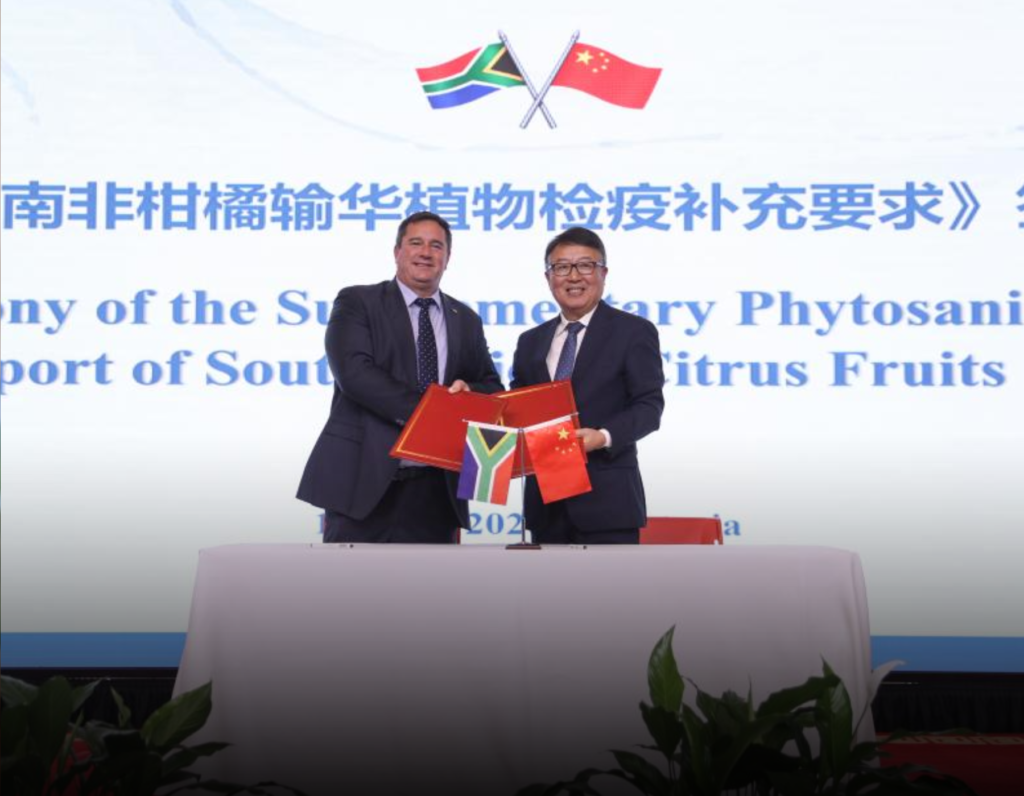
In global trade, small policy shifts can unlock massive opportunity. For South Africa’s citrus industry, that moment has arrived.
South Africa has welcomed China’s decision to ease phytosanitary requirements for citrus imports – a move expected to significantly boost exports and strengthen agricultural trade between the two nations.
The revised rules simplify cold treatment requirements for South African citrus, making it easier and more cost-effective for exporters to access the Chinese market.
Industry stakeholders say the changes will not only reduce logistical challenges but also improve competitiveness, particularly during peak export seasons.
According to South Africa’s Citrus Growers’ Association, China has become an increasingly important destination for local producers, with demand for high-quality citrus continuing to rise. The regulatory adjustment is expected to accelerate this growth.
One industry representative described the move as “a positive step toward expanding market access and supporting the long-term sustainability of the citrus sector.”
China’s appetite for imported fruit has surged in recent years, driven by a growing middle class and increasing demand for premium agricultural products.
South Africa, known for its high-quality oranges, lemons, and mandarins, is well positioned to meet this demand. The easing of import requirements enhances its ability to compete with other global suppliers in one of the world’s largest consumer markets.
Trade analysts note that improved access could lead to higher export volumes, increased revenue for farmers, and job creation across the agricultural value chain.
The citrus breakthrough reflects a broader trend in China-South Africa relations, where agriculture is becoming an increasingly important pillar of cooperation.
China is already South Africa’s largest trading partner, with bilateral trade spanning minerals, manufactured goods, and agricultural products. In recent years, both countries have worked to expand market access for South African exports, including wine, beef, and now citrus.
These developments align with broader efforts under platforms like the Forum on China-Africa Cooperation (FOCAC), where trade facilitation and agricultural development are key priorities.
While citrus exports are in focus, the China–South Africa relationship extends far beyond agriculture.
The two countries collaborate across infrastructure, energy, science and technology, and global governance platforms such as BRICS. Chinese investment in South Africa’s energy and industrial sectors continues to grow, while educational and cultural exchanges are strengthening people-to-people ties.
For South Africa’s citrus industry, the policy shift is more than a regulatory adjustment, it is a strategic opening.
It provides an opportunity to scale exports, strengthen global competitiveness, and deepen integration into international agricultural markets.
But as with all trade opportunities, success will depend on consistency, quality, and the ability to meet evolving market standards.
What this moment represents is simple but powerful: access creates possibility.
For South Africa, the Chinese market is no longer distant, it is increasingly within reach. For China, diversified agricultural imports strengthen food security and consumer choice.
And for both, it is another step toward a partnership that continues to evolve – one shipment, one policy, one opportunity at a time.